Tuesday, August 15, 2006

Requiem

There are two hymns I want at my funeral. The first is Abide with Me, a dreary dirge to be sure, but a sine qua non for the British. It conjures up visions of dripping yews, benign vicars and the Women’s Institute preparing tea and biscuits in the Parish Hall. Ideally, I would like a full Welsh choir, but I will have to settle for a stirring rendition on an organ. The atmosphere gets gloomier and gloomier—“fast falls the eventide.” That’s a quintessential time of day for the British. Anyone who has attended evensong at Kings College, Cambridge, understands that the power of that service extends far beyond the liturgical. A crepuscular bunch, the British.

The second hymn I want is probably not suitable for a funeral, but it has great meaning for me. The melody is from Sibelius’ Finlandia, a majestic, solemn tune. Many sets of lyrics have been added to the original melody (and you can find the evolution of the piece here), but it is the words of the International version, written by Lloyd Stone, that I find so moving.


This is my song, Oh God of all the nations,
A song of peace for lands afar and mine.
This is my home, the country where my heart is;
Here are my hopes, my dreams, my sacred shrine.
But other hearts in other lands are beating,
With hopes and dreams as true and high as mine.

My country's skies are bluer than the ocean,
And sunlight beams on cloverleaf and pine.
But other lands have sunlight too and clover,
And skies are everywhere as blue as mine.
Oh hear my song, oh God of all the nations,
A song of peace for their land and for mine.

No Jingoism here, but the acknowledgement that patriotism is not the prerogative of one people and that there may be pure and noble motives in both camps.

But for a freak medical circumstance, our friend Colleen would have been in Beirut with her two small children when the fighting broke out. Our nephew Robert, with his wife and two daughters, left a week or two ago for a two-year teaching contract in Tel Aviv. They have taught in Ecuador, Sudan and Berlin. Our thoughts and prayers are with them in this new post. I am sure that the skies in both Lebanon and Israel are bluer than the ocean.

Monday, August 14, 2006

K-K-K-Katy

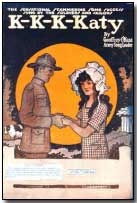
Ernie came up with a great idea for a birthday present for Kate. He was able to procure this piece of old sheet music from his brother, and he had it attractively framed for her. You can find the lyrics here and you can click on a link on the site to hear an old audio clip.

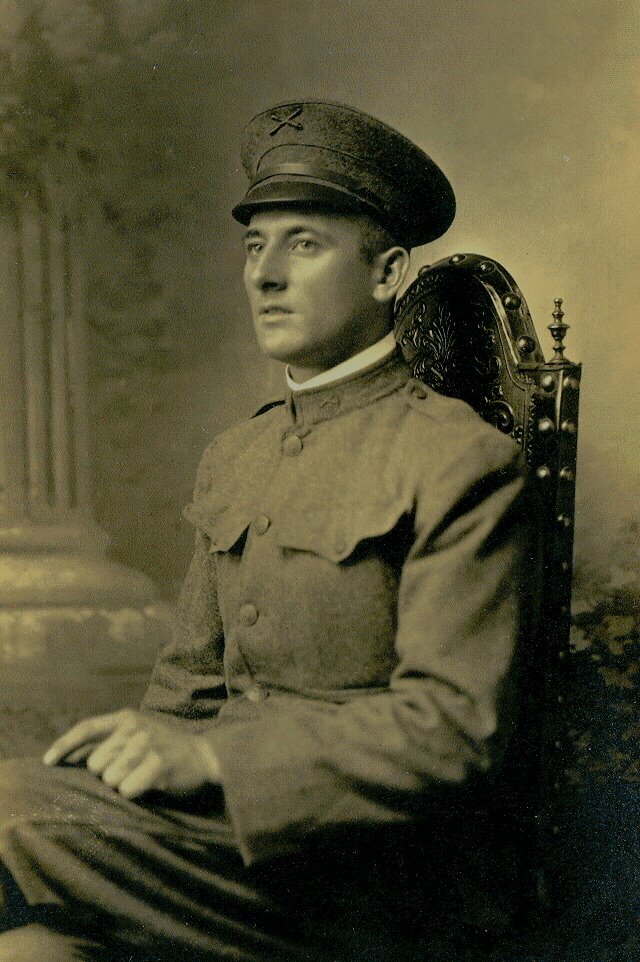
There was a pocket on the back of the frame with a photo and a note tucked in it. The photo was of Ernie's father. Ernie put the gift in its historical context for Kate and any other grandchildren reading this.

July 31, 2006

Katie—

Your grandfather, Albert Joseph Ament, enlisted at age twenty-three in the United States Army in Dubuque, Iowa, some three weeks after the United States declared war against Germany on April 6, 1917. He was the first enlistee from Dubuque County, Iowa. He enlisted in the Infantry, but later, on being sworn in, changed his branch to the Coast Artillery.

He left home on May 3rd, was sworn in at Jefferson Barracks, St. Louis, Missouri, on May 7th, and was sent to Fort Adams, Newport, Rhode Island, where he applied for and was accepted into the 7th Military Band. While stationed at Newport he took a few lessons on the cornet from Ira Holland, formerly a cornetist in the world-famous band of John Philip Sousa. Those were the first music lessons my father ever had, having been taught by his father as a child and thereafter by himself. On March 8, 1918, he applied for a transfer to the 2nd Band at Fort Williams in Portland, Maine, where there was an opening for a cornetist. While there he became a member of the 72nd Regimental Band designated for overseas duty. He was promoted to Musician First Class with sergeant’s pay of $44 per month, and on August 7th embarked for Europe from Montreal, Canada, as a member of the American Expeditionary Forces (AEF). He arrived at Le Harve, France, about three weeks later.

In France he was stationed at St. Leonard in the Haute Vienne district near Limoges. In World War I the military band played at all official military functions on the base and at company dances, marched in public parades, and in France sometimes gave local concerts to the French people. When the war ended his unit embarked from near the city of Bordeaux and arrived back in the United States on March 29, 1919. He was discharged from the Army at Camp David, Illinois, on April 17, 1919, with $90.03 in pay. His discharge papers describe him as having “blue eyes, dark brown hair, ruddy complexion,” 5’10” in height, occupation “musician,” and of “excellent” character. He arrived home to Worthington, Iowa, on Easter Saturday, April 19, 1919, having been gone almost a full two years. While he was in Europe his oldest sister Josephine died of the Spanish flu. The picture enclosed here was taken at Newport, RI, while in the army.

On returning home my father debated whether to earn his living as a professional musician, a carpenter, or a farmer. He moved to nearby Anamosa, Iowa, where he worked as a carpenter, but also as a member of the Bill Donnelly Orchestra (see the picture in our study here at home). The next year (1920) he married my mother, Laura Murray, and a few years later bought and operated with her a “dry goods” store in Anamosa. But all his life he continued to pursue his love of music, playing in various town bands and as a member of the Cedar Rapids Symphony and the East Des Moines Drum and Bugle Corps, which competed nation-wide.

“K-K-K-Katy” was a World War I song written in 1918 by Geoffrey O’Hara. We children sang it all our lives: around the piano at home, at Ament family reunions, in the car on family trips, and eventually with our own children. It now reminds me mostly of my father and you.

When I phoned my mother and father to announce that we had a baby girl whom we were naming Catherine, my father’s first words were, “My grandmother’s name was Catherine.” That was your great-great-grandmother Catherine Weis Ament, wife of Henry Ament. Their names are on the American Immigrant Wall of Honor on Ellis Island in New York. I hope you’ll see them there sometime.

When I was looking for a copy of this song for you, your Uncle Bob sent me his copy to give you.

Love . . .

© Ernest J. Ament, 2006.

Sunday, August 13, 2006

Kate, Alex and Ernie

They all had a birthday in the last couple of weeks. I like to acknowledge family birthdays, but the activity here, coupled with the heat, made me skip these three. I was also hoping my latest batch of photos would contain good portraits of these handsome people, but I didn’t even get a good one of the magnificently photogenic Alex.

So you are all off the hook for this year. Catch you next year.

Saturday, August 12, 2006

Lucy's Red Bag

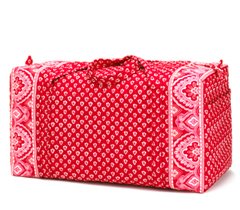
Several Christmases ago we bought Lucy a bag pretty much like this. In the intervening years, Vera Bradley has discontinued prints and designs (smart marketing ploy), and I much prefer Lucy’s bright red French Provincial print, but you get the idea. Lucy is a genius at minimalist packing and has taken the duffle everywhere as a carry-on. Picking up people at airports has become complicated these days, and we know that when Lucy gets into Detroit Metro, she will be waiting outside the terminal in short order without having to wait for checked on baggage.

Now there is a real possibility that carry-on luggage will be a thing of the past. No purses even. Personal possessions on display in baggies! It may not be for ever and I certainly understand the thinking. But I will miss seeing Lucy head off to her gate with her bright red bag over her shoulder.

Thursday, August 10, 2006

Forty Years On

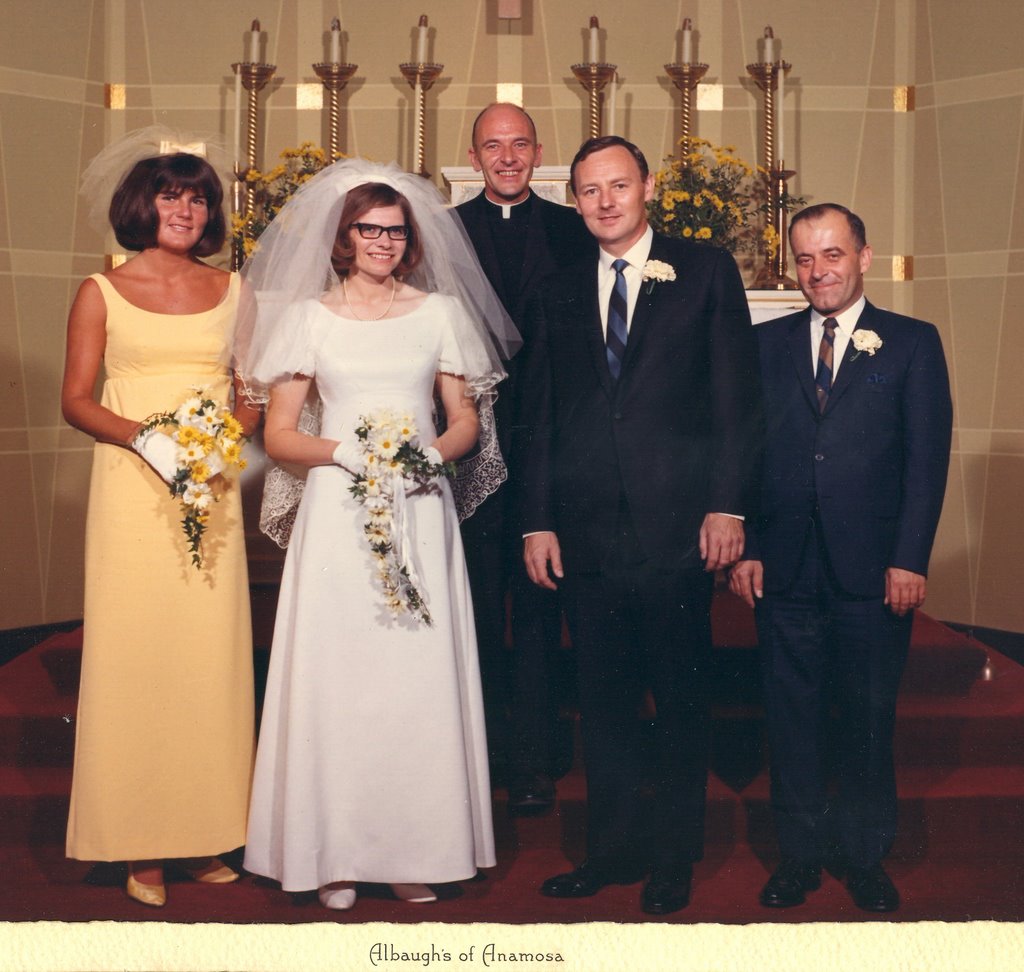
Today is our wedding anniversary. Forty years ago we were married in Anamosa, Iowa. Ernie’s brother was the celebrant. My friend from USC, Elizabeth, was our maid of honor/bridesmaid. She lives now in Berkeley, CA, and although we lost touch for a while, we are back corresponding and hope to see each other again soon. Our best man was Charles, who has gone down in family lore as the guy who accompanied us on our honeymoon. Charles has been dead for many years and we, our children and those of our friends who met him, still miss him.

We already had a big celebration two weeks ago, so we will mark this day by going out to dinner. All our children and grandchildren were home to mark the occasion and Ernie’s siblings and several nephews and nieces gathered here too. It was a wonderful reunion and there were more experiences to enter into the book of family lore. My own favorite was coming down one morning to find that Ernie’s sister, who was sleeping on the couch, had stuck notes on the casement window saying, “Do not open: bat inside.” Indeed there was. And then there will be the tale of how Ernie transported the bat across town in a cottage cheese container, so he could release him where he wouldn’t find our house again. So far he hasn’t.

There’s a lot of catching up to do, not least the laundry. I need get the photographs organized. The photo of our wedding which accompanies this post was taken by the only photographer in Anamosa. We had to reassemble at the church after the reception because he was unable to be at the church for the wedding. He had to photograph Hereford cows at the State Fair. That’s another piece of family lore.

Tuesday, August 08, 2006

1:31

That’s 1:31 p.m. and last Friday it was the time I began to feel a tad warm. Warm, mind you, after days of dripping with sweat before I had even got a pot of coffee brewed. Our last guests had left that morning and I reveled in the cool and quiet.

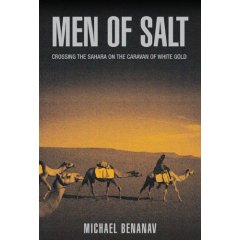
We had a house brimming with people for days (I will try to catch up on that later) and it had been uncomfortably hot for much of that time. The realization that the entire country was suffering from the heat wave made it a little more tolerable. The last book I read before everyone arrived made me feel like a real sissy when I complained about the heat. I heartily recommend Men of Salt by Michael Benanav for those of you who enjoy the exploits of travelers in wild and wooly places. Bananav and his guide Walid made the trip by camel from Timbuktu to Taoudenni in Mali. They were joined at times by an assortment of colorful characters and they returned part of the way with a caravan of nomads who still regularly make the journey to the mines at Taoudenni and return with huge slabs of salt, the White Gold of the Sahara. In truth, it could have been a boring book. Most days followed the same pattern: up at 3:00 a.m., drink tea, jump on a camel and ride for eighteen hours, with a stop or two for sand-encrusted rice and the occasional meal of unmentionable goat parts (the word rancid appears frequently). But Benanav intersperses the narrative with interesting accounts of the history of the area and the Saharan salt trade, and with anecdotes about the lives and customs of the nomads. Scorching heat and sand are his constant companions. It is a well written book and it chronicles a way of life that will not last much longer.

Thursday, July 20, 2006

They're At It Again

When we last met ”Keith”, he was busy with his product placement and attempting to interest us in the visceral world of sausage casings. He must have been checking sales orders, because he has clearly decided that flesh and offal are a lost cause as far as this family is concerned. Adopting an obscure cognitive model, he has now theorized that we are more likely to buy up-scale female athletic clothing. You know, a kind of G.I. Jane meets Heidi Klum line of garments. Wrong again, Keith. Did you miss the first week of Marketing 101? The other day a catalog arrived from Title Nine. Cute name, bad idea. Anyone who knows me understands I am unlikely to be scaling the North face of the Eiger anytime soon, and I am not one of those women who goes to the supermarket looking like she’s just come from a vigorous workout.

Nice try, Keith. Can’t wait to see what comes next.