Showing posts with label History. Show all posts

Wednesday, June 18, 2008

The Other Kennedy Boy

We were off in DC at the beginning of June when the country marked the fortieth anniversary of the assassination of Robert Kennedy. I remember how surreal the event seemed at the time. We were living in the upper unit of the duplex on Marlborough. It had two bedrooms, one of which was Ernie's study, the other was Al's nursery. We didn't own much furniture, so at the time we had our bed in the living room, along with a couch and a television. It was six weeks before Kate was born and I didn't see much point in getting up until Al woke up. Ernie was teaching summer school and was already up and getting ready. Did he turn on the television? I don't remember, but I do know that eventually I was sitting up in bed watching the tragic events unfold.


I don't know the date of this copy of the Billings Gazette capturing the visit of the democratic candidate to Montana, but we have it in our possession because the smiling woman in the center shaking Bobby Kennedy's hand is Ernie's sister Flo, and it seems important to preserve even a vicarious brush with history.

Monday, April 21, 2008

Anecdote For Today

If I am interested in a topic, I read all I can. I am about to read my third book on the exploration of the Tsangpo Gorge, even though vivid descriptions of giant leeches and yak butter-laced tea have not put it on my list of top ten places to visit. I have just finished yet another book on the Enigma code, the “unbreakable” system devised by the Germans in World War II. The machine used, together with its rotors, indicator keys, ciphers and bigrams has been to subject of many books, and even a movie which attempted to make the whole subject commercial by starring Kate Winslett. This last book, by David Kahn, is the most technical (i.e. incomprehensible) I have read, but the hard-to-follow bits were interspersed by interesting stories, one of which I am passing on.

The British assembled a team at Bletchley Park to decipher the code. This was a daunting task: the Germans estimated that if 1,000 cryptanalysts, each with a captured or copied Enigma (device), each tested four keys a minute, all day, every day, the team would take 1.8 billion years to try them all. The team of linguists and mathematicians made some headway, often helped by human error on the part of the Germans. Sometimes a cryptographer would encode a message in the naval version of Enigma and then send out the identical message to ships which did not have the Enigma machine using a code which the Allies had already broken, forming a kind of cryptographic Rosetta Stone. The best help came from captured ciphers and rotors which were recovered from torpedoed u-boats and other vessels, though German standing orders called for all such material to be thrown overboard in case of attack. The British began to consider ways of capturing keys, and the first concrete proposal came from a civilian who was the assistant to the director of naval intelligence. “I suggest”, he wrote, “we obtain the loot by the following means.

  1. Obtain from the Air Ministry an air-worthy German bomber.
  2. Pick a tough crew of five, including a pilot, a radio transmitter operator and word-perfect German speaker. Dress them in German Air Force uniform, add blood and bandages to suit.
  3. Crash plane in the Channel after making SOS to rescue service in plain language.
  4. Once aboard rescue boat, shoot German crew, dump overboard, bring rescue boat back to English port."
Initially there was a problem finding a volunteer crew, since most people agreed it was the quickest way to a posthumous Victoria Cross. But eventually a “love-sick pilot” volunteered for the kamikaze project, codenamed RUTHLESS. In the end a boat suitable for boarding never materialized and the plan was scrapped.

But the civilian who conceived this act of derringdo found other outlets for his imagination.

His name? Ian Fleming.

Saturday, February 02, 2008

Peccavi

When we returned from Chicago, we found Detroit enmeshed in a mayoral scandal. The Free Press, in a piece of investigative journalism reminiscent of Woodward and Bernstein, had unearthed text messages between the mayor and his chief-of-staff indicating that the testimony Mayor Kilpatrick had given at a trial last year was less than truthful and that the two of them were indeed engaged in extra-marital hi-jinks . Apparently hizzonner had been absent the day they covered perjury in Law School.

Now I am not going to give a homily here. Enough stones have been cast and the windows of my glasshouse are thin. So I am not going to write about the fact that the mayor’s select memory on the stand cost the city of Detroit $9,000,000 plus some considerable lawyers’ fees. I am not going to write about the firing of decent public servants who were doing their jobs with honesty and integrity, presumably with the acquiescence of the mayor’s stable of bodyguards. I am not going to discuss the fact that the “other woman” has resigned from her position as chief-of-staff and, since she is currently in Law School, will presumably never be allowed to practice law if the Wayne County prosecutor lines up her ducks. I am not going to mention that the mayor went “into seclusion” and got together a group of writers (from a Hollywood picket line?) who wrote a speech which was a masterpiece of obfuscation. I’m not going to mention the obvious parallels to another politician which came to mind as the mayor of Detroit sat there clutching his wife’s forgiving hand.

I am going to talk about language. Semantics. Word choice. Here are two extracts from the mayor’s address to the citizens of Detroit:

  • I ask you not to have helicopters flying around our home. I ask you to leave them alone. I am the mayor. I made the mistake. I am accountable.
  • I told my sons this past weekend that when you make a mistake you learn from it. You get up. You dust yourself off and you keep moving forward.
See that word that crept in there? Mistake. Somehow a mistake doesn’t call for atonement or remorse, compensation or forgiveness. Forget about the nine million dollars or the ruined lives. Mistakes are harmless little things, aren’t they?

I might not have labored the point had I not listened the very next day to an interview on NPR between Jack Lessenbury and Rep. Paul Condino. I missed the beginning of the broadcast and when I tracked it down, it appears that it dates back to 2006 and I didn’t follow up to see the outcome of the legislation that Rep. Condino was proposing. I am not opposed, under certain circumstances, to offererring clemency to a prisoner who committed murder as a juvenile. But in his analysis, which you can hear in the audio story, Mr. Lessenbury (who I think is a fine journalist) supports the legislation by saying it isn’t right for someone to be imprisoned for life for a mistake he committed as a juvenile. Murder as a mistake? If I were on the parole board I would want to hear an applicant admit to a crime, express sorrow and remorse, and prove he was ready to live an exemplary life, not take refuge in the word “mistake.” Same goes for the mayor.

And the title of this post? Let’s introduce a little levity here. It seems like the perfect time to tell my favorite classical anecdote. Anyone who remembers their Latin will tell you that “peccavi” is the Latin for “I have sinned.” Here’s the story, adapted from a letter to The New York Times:

The 1840's was a time of British expansion in India. There were those in Britain who doubted the wisdom of too rapid an advance, and in particular, the capture of the province of Sind, which was thought likely to lead to an overextension of lines of communication. (Sir Charles) Napier was therefore under express orders not to capture the territory. Once he discovered, however, how little resistance there was, he took the province with ease. He telegraphed back to headquarters a marvellous double entendre—Peccavi.

Enough of history, ethics and rhetoric for tonight.

Saturday, August 18, 2007

Kilkelly, Ireland

Thanks to Mairin O’Byrne who was kind enough to supply me with the name of the song I wrote about in my last post. She graciously supplied me with the words and you can see them if you look at her comment on the August 12 entry. I wish I could point you to the song as sung by her brother, Fergus. However, the version in this video is noteworthy for the photos and pictures of conditions in 19th century Ireland.

Friday, July 27, 2007

I 'm Not Sure of the Facts Here . . .

. . . but it is good for a giggle.

I just read a book with a background of military psychological warfare (or PsyOps as those in the know would say.) I am quoting it, but not attributing the quote, because then I would have to say I don’t think it is a very good book. Is that legal? Ethical?

One of the protagonists is reminiscing about his training and noting that the first thing they taught you in basic PsyOps training was to know the mind of your enemy.

The Iraqis were famous for their ignorance of the American culture: during Desert Storm they once put a woman on the radio we called Baghdad Betty—the Arab equivalent of Tokyo Rose. One day she announced to our troops, “While you men are fighting overseas, your wives and girlfriends back home are being seduced by Tom Cruise, Tom Selleck and Bart Simpson.”
Apparently there WAS a Baghdad Betty but she was unsuccessful and only allowed to broadcast for three months!

Monday, July 23, 2007

Where Were You . . .

. . . when the riots broke out in Detroit?

I know where I wasn’t. I wasn’t anywhere near a television set, or a newspaper or anything or anyone that alerted me to the grim events which were taking place in the city in which we had been living for nearly a year.

We were living in an upper duplex on Detroit’s east side, trying to figure out exactly what was involved with being the parents of a three-week old baby. When he slept, I slept, which explains why we hadn’t been paying attention to our usual news sources. When I got up in the morning and slipped round to the grocery store, I was surprised to find the doors locked. As I turned to leave the store and go home, I had the surreal experience of seeing tanks coming along the street toward me, together with a company of the National Guard. I asked a bystander for information and the answer sent me scurrying back home.

I don’t remember what we did for the rest of the day—I’m sure we had the television on—but I do remember that in the evening I was sitting on the little back porch of the duplex. It wasn’t the smartest place to be: we lived about five houses off Kercheval, one of the main spokes from downtown Detroit. The looting and burning were reaching out towards the suburbs via these main thoroughfares. I don’t remember being afraid. I must have been, because we could hear the gunshots and see the flames from burning buildings. I am pretty sure we didn’t even consider trying to retreat to a safer place. For Ernie it was a repeat performance: he had lived in Los Angeles during the Watts riots the year before.

By the next day things had calmed down a little and the city and its inhabitants began to count the dead and clean up the mess. I leave it to the historians and the politicians and the sociologists to analyze the causes of the riot and the repercussions. This is the fortieth anniversary of the riot. That tank rolling down our neighborhood street is a sight I will never forget.

Saturday, November 11, 2006

Another Face of War

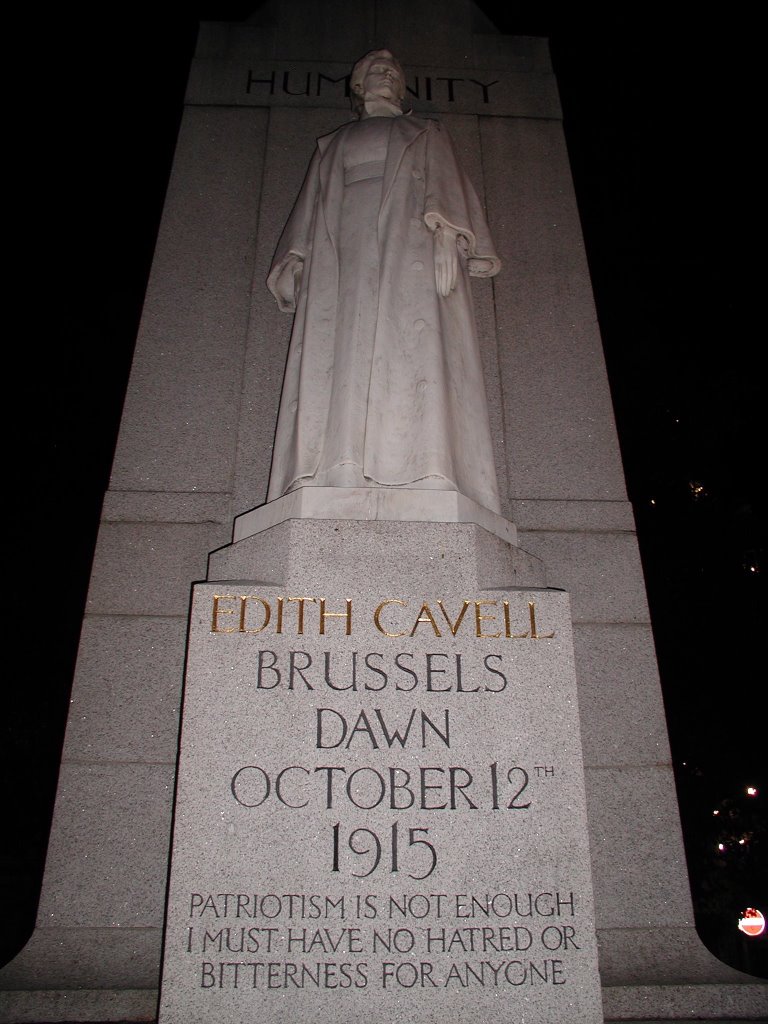
This memorial stands just off Trafalgar Square. We first came here several years ago after we visited Edith Cavell's grave in Norwich. We returned last month with Lucy.