Tuesday, August 22, 2006

One Thing Leads to Another

I’ve always wanted to try patty pan squash, so when I saw some in the grocery store today, I decided to take the plunge. When I got home, I found the cooking instructions neatly typed on the back.

Bring water to boil. Add squash, return to boil. Boil until tender, drain. Add butter or olive oil.
I despise recipes like that. I need a ballpark time: 3 minutes or half an hour? I am sure that my friend at Not a Walking Encyclopedia, she of the peppered bacon and key lime pie, has the answer on the tip of her tongue. Or I could look it up.

I actually started to do so when I discovered the photograph which accompanies my post. It is a beautiful photo (my squash are all yellow and these are prettier) and I was rummaging around the site to figure out an attribution when I came across this.

If that doesn’t make you want to become a vegetarian, nothing will.

Monday, August 21, 2006

The End of (Another) Era

It came in the mail last week: unbidden, but not entirely unexpected. It is a tasteful grey credit card, adorned with a small red star, and it allows me to buy merchandise on tick, as we used to say in England, at Macy’s. It is the result of a corporate buy-out. Macy’s has purchased Marshall Field’s which a decade or so ago purchased Hudson’s. (There was a Dayton-Hudson’s in there somewhere, but I don’t think the credit card was renamed.)

There are many divides in Detroit, mostly geographic. The most famous is of course 8 Mile Road. Slim Shady made sure that this chasm achieved worldwide fame. For the inhabitants of the Detroit metropolitan area, a more important barrier is Woodward Avenue. It separates the “East side” from the “West side.” Drivers who can navigate fearlessly and maplessly east of Woodward have been known to refuse to cross this invisible barrier for fear of getting lost. And vice versa.

There is one temporal divide in Detroit. Those on the far side are the ones who remember the J.L. Hudson Company in its glory days. When we moved to Detroit in 1966, Hudson’s was still a major force downtown. Its structure took up a whole city block. I think there were 13 floors, and one of my first memories is walking into the customer lounge on the top floor where there was a huge bank of phones. I pulled a scrap of paper out of my pocket and phoned the practice of Drs. Clifford, Rogers and Jevons. We were going to be parents!

But I never knew the store at its apogee. If you ask a longtime inhabitant of Detroit about the old days, her face will light up and she will talk of getting dressed up in white socks and patent leather shoes and going on the trolley to Hudson’s for shopping and tea with her mother or grandmother. It was the stuff of legend. That building is no more and we trot out to the mall in our jeans. Now there is a new player on the Detroit retail scene. Welcome!


I just noticed. They call themselves Macy*s, not Macy’s. Has this stellar punctuation always been their logo, or is it fear of getting entangled with the greengrocer’s apostrophe?

Saturday, August 19, 2006

The Doors

No, this isn’t a tardy encomium to Jim Morrison, but an acknowledgement that we now have two splendid entrances to our house. Just like regular people.

The newly refinished front door is still red: a tad more cranberry, a tad less scarlet. So from the street, it may not look too different, but anyone walking up the front steps will see how far we have come from the hideous plywood veneer attached by the previous owner. Now both the inside and out of the door features these attractive panels. Look at the nice pewter hardware! We didn’t have a kick plate before, which was too bad because we had to kick the door to open it, but the door was re-hung and now swings quietly and firmly into place. So that’s what they mean by curb appeal.


The back door hadn’t bothered me too much. When I told Andrew it was installed, he said “So we won’t have a quarter inch crack in the door any more?” I guess I had got used to it. The storm/screen door really wasn’t much use, with holes in the Plexiglas, which allowed drafts and small insects to enter at will. No more yelling at the grandchildren to close the screen door: this one closes all by itself. I hope some of these improvements will pay off in lower heating bills this winter. There’s certainly a smile on my face now when I put the key in the lock.

Tuesday, August 15, 2006

Requiem

There are two hymns I want at my funeral. The first is Abide with Me, a dreary dirge to be sure, but a sine qua non for the British. It conjures up visions of dripping yews, benign vicars and the Women’s Institute preparing tea and biscuits in the Parish Hall. Ideally, I would like a full Welsh choir, but I will have to settle for a stirring rendition on an organ. The atmosphere gets gloomier and gloomier—“fast falls the eventide.” That’s a quintessential time of day for the British. Anyone who has attended evensong at Kings College, Cambridge, understands that the power of that service extends far beyond the liturgical. A crepuscular bunch, the British.

The second hymn I want is probably not suitable for a funeral, but it has great meaning for me. The melody is from Sibelius’ Finlandia, a majestic, solemn tune. Many sets of lyrics have been added to the original melody (and you can find the evolution of the piece here), but it is the words of the International version, written by Lloyd Stone, that I find so moving.


This is my song, Oh God of all the nations,
A song of peace for lands afar and mine.
This is my home, the country where my heart is;
Here are my hopes, my dreams, my sacred shrine.
But other hearts in other lands are beating,
With hopes and dreams as true and high as mine.

My country's skies are bluer than the ocean,
And sunlight beams on cloverleaf and pine.
But other lands have sunlight too and clover,
And skies are everywhere as blue as mine.
Oh hear my song, oh God of all the nations,
A song of peace for their land and for mine.

No Jingoism here, but the acknowledgement that patriotism is not the prerogative of one people and that there may be pure and noble motives in both camps.

But for a freak medical circumstance, our friend Colleen would have been in Beirut with her two small children when the fighting broke out. Our nephew Robert, with his wife and two daughters, left a week or two ago for a two-year teaching contract in Tel Aviv. They have taught in Ecuador, Sudan and Berlin. Our thoughts and prayers are with them in this new post. I am sure that the skies in both Lebanon and Israel are bluer than the ocean.

Monday, August 14, 2006

K-K-K-Katy

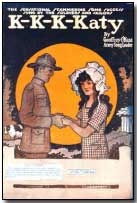
Ernie came up with a great idea for a birthday present for Kate. He was able to procure this piece of old sheet music from his brother, and he had it attractively framed for her. You can find the lyrics here and you can click on a link on the site to hear an old audio clip.

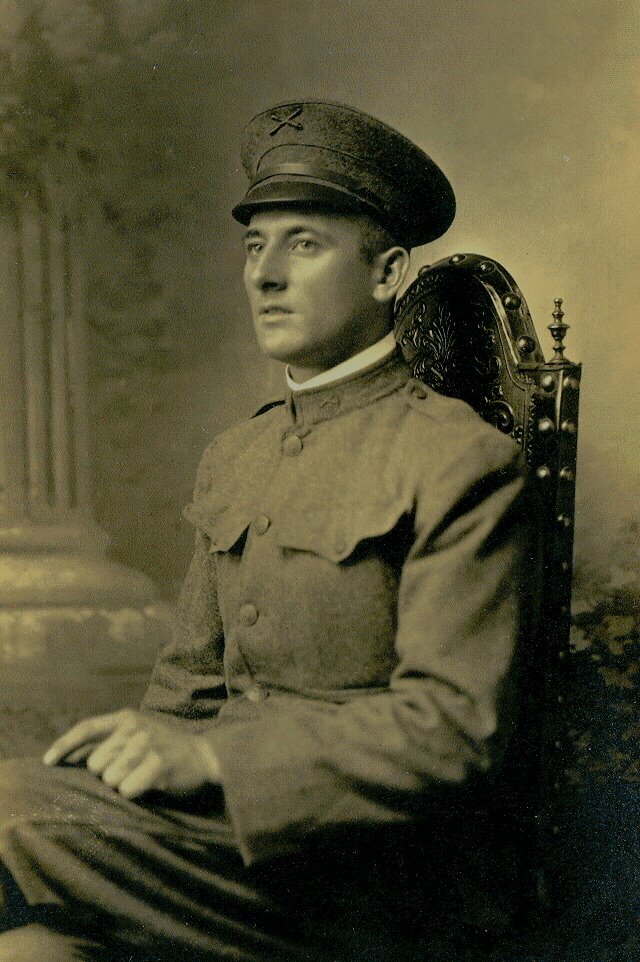
There was a pocket on the back of the frame with a photo and a note tucked in it. The photo was of Ernie's father. Ernie put the gift in its historical context for Kate and any other grandchildren reading this.

July 31, 2006

Katie—

Your grandfather, Albert Joseph Ament, enlisted at age twenty-three in the United States Army in Dubuque, Iowa, some three weeks after the United States declared war against Germany on April 6, 1917. He was the first enlistee from Dubuque County, Iowa. He enlisted in the Infantry, but later, on being sworn in, changed his branch to the Coast Artillery.

He left home on May 3rd, was sworn in at Jefferson Barracks, St. Louis, Missouri, on May 7th, and was sent to Fort Adams, Newport, Rhode Island, where he applied for and was accepted into the 7th Military Band. While stationed at Newport he took a few lessons on the cornet from Ira Holland, formerly a cornetist in the world-famous band of John Philip Sousa. Those were the first music lessons my father ever had, having been taught by his father as a child and thereafter by himself. On March 8, 1918, he applied for a transfer to the 2nd Band at Fort Williams in Portland, Maine, where there was an opening for a cornetist. While there he became a member of the 72nd Regimental Band designated for overseas duty. He was promoted to Musician First Class with sergeant’s pay of $44 per month, and on August 7th embarked for Europe from Montreal, Canada, as a member of the American Expeditionary Forces (AEF). He arrived at Le Harve, France, about three weeks later.

In France he was stationed at St. Leonard in the Haute Vienne district near Limoges. In World War I the military band played at all official military functions on the base and at company dances, marched in public parades, and in France sometimes gave local concerts to the French people. When the war ended his unit embarked from near the city of Bordeaux and arrived back in the United States on March 29, 1919. He was discharged from the Army at Camp David, Illinois, on April 17, 1919, with $90.03 in pay. His discharge papers describe him as having “blue eyes, dark brown hair, ruddy complexion,” 5’10” in height, occupation “musician,” and of “excellent” character. He arrived home to Worthington, Iowa, on Easter Saturday, April 19, 1919, having been gone almost a full two years. While he was in Europe his oldest sister Josephine died of the Spanish flu. The picture enclosed here was taken at Newport, RI, while in the army.

On returning home my father debated whether to earn his living as a professional musician, a carpenter, or a farmer. He moved to nearby Anamosa, Iowa, where he worked as a carpenter, but also as a member of the Bill Donnelly Orchestra (see the picture in our study here at home). The next year (1920) he married my mother, Laura Murray, and a few years later bought and operated with her a “dry goods” store in Anamosa. But all his life he continued to pursue his love of music, playing in various town bands and as a member of the Cedar Rapids Symphony and the East Des Moines Drum and Bugle Corps, which competed nation-wide.

“K-K-K-Katy” was a World War I song written in 1918 by Geoffrey O’Hara. We children sang it all our lives: around the piano at home, at Ament family reunions, in the car on family trips, and eventually with our own children. It now reminds me mostly of my father and you.

When I phoned my mother and father to announce that we had a baby girl whom we were naming Catherine, my father’s first words were, “My grandmother’s name was Catherine.” That was your great-great-grandmother Catherine Weis Ament, wife of Henry Ament. Their names are on the American Immigrant Wall of Honor on Ellis Island in New York. I hope you’ll see them there sometime.

When I was looking for a copy of this song for you, your Uncle Bob sent me his copy to give you.

Love . . .

© Ernest J. Ament, 2006.

Sunday, August 13, 2006

Kate, Alex and Ernie

They all had a birthday in the last couple of weeks. I like to acknowledge family birthdays, but the activity here, coupled with the heat, made me skip these three. I was also hoping my latest batch of photos would contain good portraits of these handsome people, but I didn’t even get a good one of the magnificently photogenic Alex.

So you are all off the hook for this year. Catch you next year.

Saturday, August 12, 2006

Lucy's Red Bag

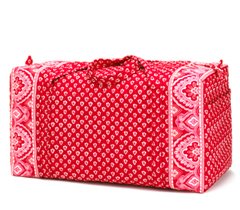
Several Christmases ago we bought Lucy a bag pretty much like this. In the intervening years, Vera Bradley has discontinued prints and designs (smart marketing ploy), and I much prefer Lucy’s bright red French Provincial print, but you get the idea. Lucy is a genius at minimalist packing and has taken the duffle everywhere as a carry-on. Picking up people at airports has become complicated these days, and we know that when Lucy gets into Detroit Metro, she will be waiting outside the terminal in short order without having to wait for checked on baggage.

Now there is a real possibility that carry-on luggage will be a thing of the past. No purses even. Personal possessions on display in baggies! It may not be for ever and I certainly understand the thinking. But I will miss seeing Lucy head off to her gate with her bright red bag over her shoulder.